
WASHINGTON – The search for the dead in the apparentU.S. or Israeli missile strikeon the Shajareh Tayyebehall-girls' elementary schoolin Iran has officially ended.
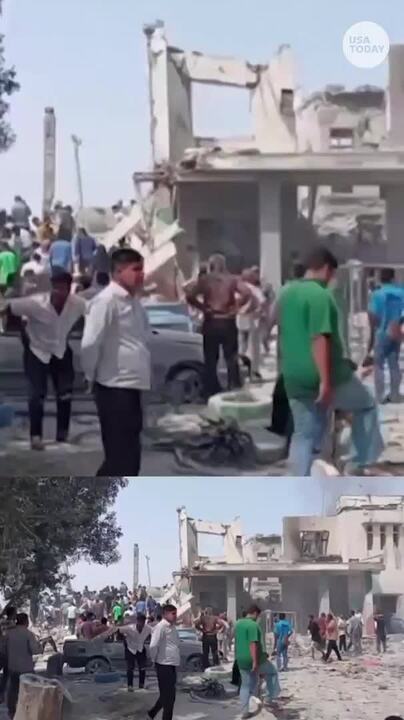
But the questions surrounding the attack that killed at least 175 people have just begun, as international condemnation and calls for investigations – and accountability – were amplified on March 2.
"All alleged violations − including indiscriminate or disproportionate attacks, deliberate targeting of civilians or civilian infrastructure, and attacks on medical facilities and schools − must be promptly, independently, and transparently investigated," one of the world's oldest human rights organizations, the Paris-based International Federation for Human Rights (FIDH), said in a March 2 statement.
"Where evidence of war crimes or other serious violations is found," it added, "those responsible, regardless of rank or official capacity, must be held accountable in accordance with international law."
The Trump administration has neither ruled out nor admitted responsibility for the attack, which occurred during the opening wave of the U.S.-led operations on Feb. 28.
The Pentagon says it is reviewing the incident, but so far it has not publicly committed to a formal investigation, disciplinary action or other accountability measures.
"It would be difficult to establish a lawful basis for the strike on the school building at a time when it is full of children," David Scheffer, an international law expert who served as the first U.S. Ambassador-at-Large for War Crimes Issues, told USA TODAY. "It likely is a mistaken targeting decision or based on flawed intelligence about the use of that building."
Here's what to know.
What happened at Shajareh Tayyebeh?
The military strike on the elementary school in Minab, in the southern Hormozgan province near the Sea of Oman, is considered one of the biggest civilian casualty attacks in the newly launched U.S.-Israel war against Iran.
President Donald Trumphas defended the war as necessary in depriving a hostile enemy of nuclear weapons and missile capabilities.
The majority of victims were children, including dozens of young girls between the ages of 7 and 12, according to theIranian news agency IRNA and Iranian officials, in what they allege was an indiscriminate attack on civilians.
Hossein Kermanpour, a spokesman for Iran's health ministry,shared an X post on Feb. 28, calling the majority of those killed at the school "young child martyrs."
"God knows how many more children will be pulled out of the rubble," he wrote. "May God give their families strength and patience."
When the strike hit, the school washolding its first of multiple rotating school shifts, according to Hengaw, a Norway-based organization focusing on human rights violations in Iran. The group added that around 170 students are enrolled in the school's morning shift; however, it is unclear how many were in the building during the strike.
Why was the school struck?
It was not immediately clear why the school was targeted, but old satellite images indicate that the school was previously connected to a facility of Iran's Islamic Revolutionary Guard Corps, or IRGC. Recent satellite images from 2016 showed that the school had since been separated from the IRGC base by a wall,The New York Timesreported.
Video footage of the area circulated online appears to show that the IRGC base was also targeted in the attack, which occurred during the opening phase of the U.S.-Israeli military campaign that began Feb. 28.

What do US officials say?
So far, the response from the Trump administration has been muted.
The White House has not commented. The Defense Department has offered little response except to say it is probing reports of civilian casualties.
"We are aware of reports concerning civilian harm resulting from ongoing military operations. We take these reports seriously and are looking into them," said Capt. Tim Hawkins, a spokesperson for the U.S. Central Command, which oversees American military operations in the region.
Advertisement
"The protection of civilians is of utmost importance," Hawkins said, "and we will continue to take all precautions available to minimize the risk of unintended harm."
The bombing of the school did not come up at Secretary of DefensePete Hegseth's news briefing March 2 with the chairman of the Joint Chiefs of Staff, Gen. Dan Caine.
But Hegseth described the mission of the U.S. campaign, dubbed "Operation Epic Fury," as being "laser-focused" on destroying Iran's nuclear and missile capabilities.
"We're hitting them surgically, overwhelmingly and unapologetically," Hegseth told reporters.
"As the President warned," Hegseth also said, "an effort of this scope will include casualties. War is hell and always will be."
What do war crimes and humanitarian laws say?
Such attacks on schools, especially intentional ones, can be war crimes under international and even U.S. rules of engagement, legal experts told USA TODAY March 2.
At the very least, they are grounds for intensive investigations into how the target was chosen, who authorized it and whether it was intentional.
Col. Morris Davis, a former war crimes prosecutor who retired as the director of the Air Force Judiciary, said the laws of war are clear: Schools and other civilian targets cannot be targeted unless there is clear evidence that enemy forces are using the facility for operations, to store weapons, to quarter troops or for other acts of war.

"You saw that in Gaza, where you can have a protected site that is converted to a prohibited use, and it loses protected status," Davis said.
"Obviously, this is a monumental incident and typically an investigation would be convened to determine two things," said Davis, the former chief prosecutor at the U.S. military base in Guantanamo Bay. "One is to determine accountability, and another for lessons learned. How do we prevent this from happening again?"
In an investigation, some of the questions that should be asked would include: Was the school the intended target? Was it struck while attacking the nearby IRGC facility? And if so, what intelligence supported the strike, and were civilian risk estimates conducted?
Such investigations would be ordered and overseen by the military leader in charge of that theater, according to military policy, in this case, the commander of Central Command, Davis told USA TODAY.
"But I think that's something that in the current environment, would be a good way to be unemployed come Monday," Davis said, citing remarks about the current war by Hegseth and other officials. "So do I expect anybody to be held accountable? No."
What are human rights organizations saying?
Iran's government labeled the attack on the school a war crime and demanded action by the United Nations.
UNESCO, the United Nations Educational, Scientific and Cultural Organization, alsocondemned the attackon the school as "a grave violation of humanitarian law."

UNSecretary-General António Guterresalso condemned the attack, as well as the retaliatory strikes by Iran that hit several Middle Eastern countries.
The International Federation for Human Rights was one of numerous organizations to call on the U.S. and Israel to quickly investigate the matter to determine who ordered the strike, what information they possessed at the time.
The group singled out the attack on the school targeting civilian infrastructure, saying "a majority" of the victims were children. But it cited other reports indicating that hundreds of civilians have also been killed in various Iranian cities, including in attacks on hospitals.
Contributing: Jonathan Limehouse
This article originally appeared on USA TODAY:Rights groups want answers in attack on Iran girls school. Here's why


![Inside Psalm West’s over-the-top firefighter-themed birthday party including Dalmatian dessert bar and custom jackets ... https://ift.tt/CbdwBap
#us
#uk
#world
#politics
#top
#news
#readmore
PSALM West has had a massive firefighter-themed birthday party.
His mom, Kim Kardashian, made sure every detail was covered to guarantee a fiery good time.
Psalm actually turns four on Tuesday, but the Kardashians have never said no to a party.
Kim held Psalm as family and friends sang Happy Birthday[/caption]
A massive spread greeted guests[/caption]
Kim, 42, turned her entire home into its own fire station, complete with fire truck pinata and fire hydrant cake.
Each young attendee was gifted their own custom firefighter turnout jackets featuring each of the children’s names stitched on the back, along with “CALABASAS FD” on some and “LA CO FD” on others.
The entranceway was covered to look like the outside of a fire station, complete with Psalm’s name spelled out at the top.
The backyard was decorated to look like a firehouse[/caption]
Inside the theme continued with paintings of the siblings in uniforms.
Psalm was given his own firefighter locker, jammed with his uniform, two pairs of boots and a rolled up hose.
Psalm had his own locker[/caption]
Drawings and paintings of the Kardashian kids decorated the walls[/caption]
Just outside, a giant balloon fire raged, as a life-size balloon fireman battled it.
Several station themed bounce houses were scattered about the backyard, including one that looked like a snow globe filled with balloon snowflakes.
A colorful dalmatian cutout stood guard over trays of cupcakes just begging to be eaten.
Adults could beat the heat with some custom cocktails.
Adults had their own drink menu[/caption]
One was named the “Extinguish Your Thirst” and included dragon fruit, lemon, and simple syrup while another was called the “Red Engine” and featured 7Up, grenadine, and cherries.
There was also a fire engine pinata, which Psalm and his cousins True, Dream and Stormi each attacked.
Guests took a whack at a fire truck pinata[/caption]
B-DAY BASHFUL
Kim helped Psalm blow out the candles[/caption]
When the time came to serenade Psalm with Happy Birthday, he suddenly turned very bashful.
Kim held her youngest born next to the massive firefighter-themed cake as he shyly waited for the guests to finish singing.
The Hulu star was shown helping her son blow out the candles once the song was complete.
The cake was a multi-layered work of art[/caption]
The layered cake was decorated to include a firefighter helmet on top of a red fire hydrant.
Below it, fire and smoke billowed near the center, along with a fire hose.
At the bottom, the honorary title “Chief Psalm” was written across the cake.
KIM’S BIGGEST FAN
True shows her aunt some love[/caption]
While the kids all dressed to impress, Khloe Kardashian‘s daughter went a step further.
True, five, showed up wearing a custom-made “Kim Kardashian” T-shirt.
The black shirt featured past snapshots of the Skims founder wearing iconic ensembles that she has made famous over the years.
True smiled in the photo as she sported her hair in a pair of buns and showed off her chalk-covered hands.
PSALM FOR PSALE
Psalm was born in 2019[/caption]
Psalm’s empire has only started to grow.
Last year, the U.S. Sun revealed a slew of new trademarks were filed for the toddler, teasing the possibilities of Psalm toys and clothing.
Kim’s first of 12 trademarks covers “non-medicated skin care preparations; skin moisturizers; skin lotions; skin creams; skin cleansers” and other various cosmetics.
The second filing includes: “Probiotic supplements; nutritional supplements; vitamins; baby diapers; baby cloth diapers; anti-inflammatory ointments; baby food; infant formula.”
Psalm’s third trademark contains: “Strollers; stroller covers; children’s car seats; fitted covers for children’s car seats.”
The fourth promises “clocks; jewelry; watches; keychains” while the fifth dabbles in “calendars; books; magazines and periodicals in the fields of music; entertainment” and more.
The sixth trademark states Psalm’s business future could include “baby carriers worn on the body; all-purpose carrying bags; backpacks; handbags; tote bags; purses; wallets; bags for carrying babies’ accessories; diaper bags” and more.
Psalm’s seventh trademark branches out into “furniture; cribs; baby bouncers; baby changing mats; baby walkers; mattresses; cushions; nursing pillows; foot stools; mirrors” and more.
A giant firefighter balloon battled a raging flame[/caption]
Similarly, the eighth filing states: “Textiles for home furnishings, namely, household linens, bath linens, bed linens, kitchen linens, and table linens; drapery; afghans; throws; comforters; bed blankets; baby bedding, namely, swaddling blankets, crib bumpers” and more.
However, Kim’s ninth trademark for her son includes various clothing items such as “coats; dresses; footwear; headwear; jackets; jumpers; loungewear; rompers; scarves; shirts” and more.
The tenth includes “toy figures; doll accessories; puzzles; party games; toy jewelry; puppets; hand-held units for playing electronic games; children’s educational toys for developing fine motor and cognitive skills” and more.
Psalm’s eleventh and twelfth filings promise “advertising services, namely, promoting the brands, goods, and services of others; endorsement services” and “entertainment in the nature of providing information by means of a global computer network in the fields of entertainment and pop culture; entertainment services, namely, personal appearances by a celebrity.”
Psalm’s last trademarks were all filed in 2019, so it looks like the young toddler was due for a fresh update of permit applications.
Psalm battled the pinata in full costume[/caption]
#Inside Psalm West’s over-the-top firefighter-themed birthday party including Dalmatian dessert bar and custom jackets
https://ift.tt/BsXAv52](https://lh3.googleusercontent.com/blogger_img_proxy/AEn0k_s1TAhQEQURuC660n7vJ1grywSNxb3yW-_5HIBHT-Dv6LhdZGeUrRyIuKzlYYyWjaQnw52E5epTQk9RbMmB8jHoaJpz9QMxJkHQnTwZ-BoRSacC7FrBClozEJfnLNG2O4iRn4W3dqnqztkpt-5cr9o4rCCi95-9GX8H9r-5WwXUK1lAmEV8k3hMUKss_DsKTbWwpNJkFxpazqNf8-xLmOpDvmP7lJvYkbWB2aBWGDdPnVxY7VcCp652BMahpHXo-ypifcqTinYi6Z-ZyIdl-KvEnyp40VxUjj-GPoP6stczkxteKdmbLlQ7peq5Kti3z601L4xVmlAnxQrhqY8N5dm-Br7Q30EhFiDIODc1ejdFt7rzFb4u811ynPbE8nVnjdHrBPJtcSBKR-J-eTEO6gSxsq-yk4w=w72-h72-p-k-no-nu)


0 Comments